What are the Key Factors to Keep in Mind in Lavender Oil Manufacturing?
Lavender essential oil is one of the world's most recognized botanical oils, widely used in aromatherapy, cosmetics, personal care, wellness products, massage oils, soaps, candles, home fragrances, and premium skincare formulations. As international demand continues to grow, manufacturers must focus on much more than simply extracting oil from lavender flowers. Consistent quality, sustainable sourcing, proper distillation techniques, laboratory testing, packaging standards, and export compliance all play a significant role in producing premium-grade lavender essential oil.
For global buyers, cosmetic brands, aromatherapy companies, and private-label businesses, selecting a manufacturer that follows international manufacturing standards is equally important. High-quality lavender oil delivers consistent aroma, purity, and chemical composition while meeting regulatory requirements in overseas markets.
If you're new to lavender oil, you may also enjoy reading our guide on What is Lavender Essential Oil? Benefits and Market Demand, which explains its growing popularity across cosmetic and wellness industries.
Understanding Lavender Essential Oil Manufacturing
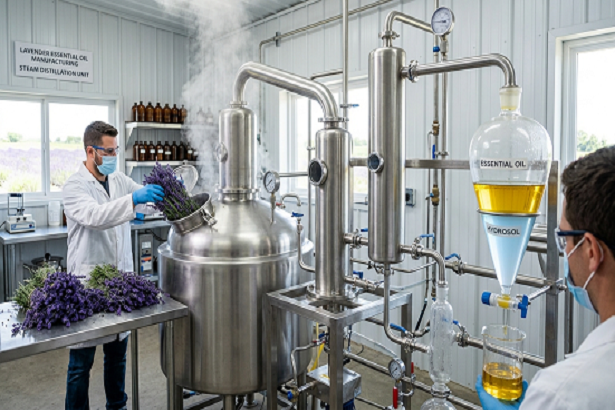
Lavender essential oil is primarily extracted from the flowering tops of the lavender plant using the steam distillation process. The quality of the final oil depends on several interconnected factors, including plant variety, harvesting stage, cultivation methods, climate conditions, distillation parameters, storage, filtration, and laboratory verification.
Premium manufacturers carefully monitor every stage of production because even minor variations can significantly affect aroma profile, active constituents, oxidation stability, and international acceptance.
Modern essential oil manufacturers combine traditional botanical knowledge with advanced manufacturing technologies, automated distillation systems, stainless-steel processing equipment, and internationally recognized quality assurance practices.
Businesses looking for reliable suppliers should also understand how manufacturers compare with one another. Our detailed guide How to Choose a Reliable Essential Oil Exporter explains important supplier evaluation criteria.
Key Factors That Affect Lavender Essential Oil Quality
Producing export-quality lavender oil requires attention to multiple quality parameters rather than focusing on extraction alone. Professional manufacturers typically establish strict Standard Operating Procedures (SOPs) to ensure every production batch maintains consistent quality.
1. Quality of Lavender Flowers
Everything begins with premium-quality lavender flowers. Healthy plants cultivated in suitable climatic conditions generally produce higher concentrations of aromatic compounds and yield superior essential oil.
- Proper botanical identification
- Healthy flowering plants
- Correct harvesting season
- Minimal contamination
- Optimal moisture level
- Fresh processing after harvest
2. Harvest Timing
Harvesting lavender at the appropriate flowering stage has a major influence on both oil yield and aroma profile. Flowers harvested too early or too late may produce reduced essential oil content or altered fragrance characteristics.
Professional growers monitor flowering maturity carefully before beginning commercial harvesting.
3. Steam Distillation Equipment
High-grade stainless-steel distillation units are preferred for commercial production because they preserve oil quality while minimizing contamination risks.
Proper steam pressure, temperature control, condensation efficiency, and separation systems all contribute to maintaining the natural composition of lavender essential oil.
4. Water Quality
Since steam plays a central role in extraction, purified water is extremely important. High mineral content or contaminated water may negatively affect production efficiency and final product quality.
5. Manufacturing Hygiene
International buyers increasingly evaluate manufacturing facilities for cleanliness, traceability, and Good Manufacturing Practices (GMP). Hygienic production environments help reduce contamination risks while improving product consistency.
Comparison of Good Manufacturing Practices
| Manufacturing Factor | Professional Manufacturer | Poor Manufacturing Practice |
|---|---|---|
| Raw Material | Fresh premium lavender flowers | Old or mixed-quality flowers |
| Distillation | Controlled steam distillation | Improper temperature control |
| Equipment | Food-grade stainless steel | Low-grade equipment |
| Testing | GC-MS & purity verification | Limited or no testing |
| Packaging | Export-grade containers | Standard packaging |
| Traceability | Complete batch records | Limited documentation |
Manufacturers serving international markets also prioritize sustainable sourcing and transparent quality systems. Buyers increasingly prefer suppliers who can demonstrate consistent manufacturing processes backed by laboratory documentation and export experience.
Understanding extraction technology is equally important. If you're interested in learning why production methods matter, read our article Steam Distilled vs Cold Pressed Oils, which explains how extraction techniques influence essential oil quality and applications.
In the next section, we'll explore the complete steam distillation process, laboratory quality testing, GC-MS analysis, packaging standards, and the international export requirements that reputable lavender essential oil manufacturers follow.
Steam Distillation Process for Premium Lavender Essential Oil
Steam distillation is the internationally accepted method for producing high-quality lavender essential oil. The objective is to extract volatile aromatic compounds while preserving their natural chemical composition. Manufacturers serving cosmetic, aromatherapy, pharmaceutical, and wellness industries rely on controlled distillation systems to ensure consistency from batch to batch.
Unlike solvent extraction, steam distillation does not introduce chemical residues into the finished product. This makes the oil suitable for a wide variety of personal care and aromatherapy formulations when manufactured according to recognized quality standards.
Typical Lavender Oil Manufacturing Process
| Manufacturing Stage | Purpose |
|---|---|
| Raw Material Inspection | Verify botanical identity and freshness |
| Cleaning | Remove dust, foreign particles and impurities |
| Loading Distillation Unit | Prepare flowers for controlled steam exposure |
| Steam Distillation | Extract volatile aromatic compounds |
| Condensation | Convert vapor into liquid form |
| Oil Separation | Separate essential oil from hydrosol |
| Filtration | Improve clarity and remove suspended particles |
| Laboratory Testing | Verify purity and chemical composition |
| Packing | Fill into export-grade containers |
| Storage | Protect quality before shipment |
Modern manufacturing facilities use automated monitoring systems that control steam pressure, extraction duration, and condensation efficiency. These controls help maximize oil recovery while maintaining the desired aroma profile.
Quality Testing and Laboratory Analysis
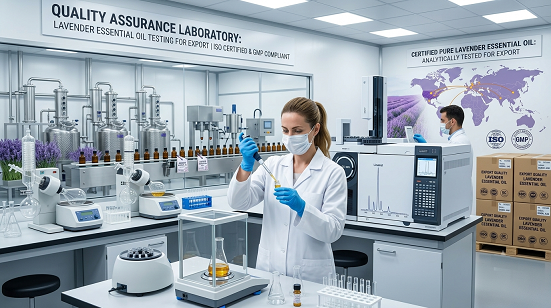
International buyers expect every shipment of lavender essential oil to be supported by documented quality testing. Laboratory analysis provides confidence that the product meets agreed specifications before export.
Professional manufacturers perform multiple quality checks throughout production rather than testing only the final product.
Important Laboratory Tests
- GC-MS (Gas Chromatography-Mass Spectrometry) profile
- Appearance evaluation
- Colour verification
- Specific Gravity
- Refractive Index
- Optical Rotation (where applicable)
- Solubility evaluation
- Flash Point
- Microbial assessment when required
- Heavy Metal testing
- Pesticide residue evaluation (if requested)
- Shelf-life stability assessment
Among these, GC-MS testing is particularly valuable because it identifies the natural aromatic constituents present in lavender essential oil. This helps manufacturers demonstrate product authenticity while supporting consistent quality across production batches.
At Shree Overseas Exports, quality assurance focuses on maintaining product consistency, traceability, and documentation suitable for international buyers across cosmetic, aromatherapy, wellness, and personal care industries.
Why Batch Consistency Matters
Many international brands develop formulations that require identical raw materials throughout the year. Even small variations in aroma or composition can influence the performance of finished products.
Professional manufacturers therefore implement batch traceability systems that record:
- Harvest details
- Production date
- Raw material source
- Distillation batch number
- Laboratory reports
- Packaging records
- Export documentation
Such documentation helps manufacturers maintain transparency while simplifying audits for international customers.
Export Packaging and International Compliance
Proper packaging is just as important as manufacturing. Lavender essential oil is sensitive to light, heat, oxygen, and contamination. Export packaging protects product integrity throughout storage and international transportation.
Features of Export-Quality Packaging
- Food-grade containers
- Leak-proof sealing
- Tamper-evident caps
- Light-protective containers
- Proper batch labeling
- Export-ready cartons
- Moisture-resistant secondary packaging
- Palletized shipping where required
Professional exporters also prepare documentation that may include:
- Certificate of Analysis (COA)
- Material Safety Data Sheet (MSDS/SDS)
- Technical Data Sheet (TDS)
- Certificate of Origin
- Phytosanitary documents (where applicable)
- Commercial Invoice
- Packing List
For businesses planning international sourcing, our detailed article What are the Export Standards for Lavender Essential Oil? provides additional guidance on quality documentation and export requirements.
You can also explore our guide on Private Label Essential Oils Manufacturing in India to understand how experienced manufacturers support OEM and private-label brands worldwide.
Industry Best Practices Followed by Leading Manufacturers
- Strict supplier qualification procedures
- Complete batch traceability
- Controlled manufacturing environment
- Regular equipment maintenance
- Validated cleaning procedures
- Comprehensive laboratory testing
- International documentation support
- Customer-specific packaging solutions
- Private labeling capabilities
- Continuous quality improvement programs
As demand for natural ingredients continues to rise globally, manufacturers who invest in modern production technology, experienced technical teams, sustainable sourcing, and internationally accepted quality systems are better positioned to serve cosmetic brands, wellness companies, aromatherapy businesses, and global importers.
Reference: The International Organization for Standardization (ISO) publishes internationally recognized standards that support quality management systems and manufacturing best practices across industries.
In the final section, we'll discuss how to choose the right lavender oil manufacturer, common buyer mistakes to avoid, an author section, FAQs, references, and the concluding recommendations.
How to Choose the Right Lavender Essential Oil Manufacturer
Selecting the right manufacturing partner is one of the most important decisions for importers, distributors, cosmetic brands, aromatherapy companies, and private-label businesses. A dependable manufacturer not only supplies premium-quality lavender oil but also ensures regulatory compliance, timely delivery, technical support, and long-term consistency.
Rather than selecting a supplier solely based on price, businesses should evaluate the manufacturer's overall capability, production infrastructure, quality systems, export experience, and customer support.
Checklist for Choosing a Reliable Manufacturer
- Experienced essential oil manufacturer
- Modern steam distillation facility
- Strict quality assurance procedures
- GC-MS laboratory testing available
- Batch traceability system
- Private Label (OEM) manufacturing capability
- Flexible packaging options
- International export experience
- Complete export documentation
- Responsive technical support
Companies looking for long-term sourcing relationships should also evaluate manufacturing transparency, sustainability initiatives, and the ability to customize products according to market requirements.
Common Mistakes Buyers Should Avoid
| Mistake | Recommended Approach |
|---|---|
| Choosing only by price | Compare quality, certifications and manufacturing capability |
| Ignoring laboratory reports | Request COA and GC-MS documentation |
| No supplier audit | Evaluate manufacturing infrastructure |
| Ignoring packaging quality | Verify export-grade packaging standards |
| Purchasing inconsistent batches | Select manufacturers with batch traceability |
| No documentation verification | Confirm export documents before shipment |
Why Shree Overseas Exports?
Shree Overseas Exports is committed to manufacturing premium-quality essential oils for global markets through carefully controlled production processes, quality assurance systems, and customer-focused manufacturing practices. Our manufacturing approach emphasizes consistency, purity, traceability, and international compliance.
We serve customers across multiple industries, including:
- Aromatherapy Brands
- Cosmetic Manufacturers
- Skincare Companies
- Hair Care Manufacturers
- Spa & Wellness Brands
- Private Label Businesses
- Natural Personal Care Companies
- International Importers & Distributors
Whether your requirement is bulk supply, OEM manufacturing, or export-ready lavender essential oil, our experienced team focuses on delivering products that meet international expectations for quality and consistency.
Conclusion
Manufacturing premium lavender essential oil requires much more than steam distillation. Every stage—from selecting healthy lavender flowers to laboratory testing, hygienic production, quality assurance, packaging, and export documentation—plays an essential role in determining the final product's quality.
As global demand for natural botanical ingredients continues to increase, manufacturers who invest in advanced production technology, skilled technical teams, internationally recognized quality systems, and transparent manufacturing practices are best positioned to meet customer expectations.
Businesses looking for reliable suppliers should prioritize manufacturers that demonstrate technical expertise, export capability, documented quality assurance, and long-term consistency. These factors not only improve product performance but also help establish trusted partnerships in international markets.
Frequently Asked Questions (FAQs)
1. Which extraction method is best for lavender essential oil?
Steam distillation is considered the most widely accepted method because it efficiently extracts aromatic compounds while preserving the oil's natural characteristics.
2. Why is GC-MS testing important?
GC-MS testing helps verify the authenticity, purity, and chemical composition of lavender essential oil, making it one of the most important quality assessment methods.
3. What documents are usually provided for export?
Export shipments commonly include a Certificate of Analysis (COA), Technical Data Sheet (TDS), Safety Data Sheet (SDS/MSDS), Packing List, Commercial Invoice, and other documents depending on destination country requirements.
4. Why is packaging important during export?
Proper export packaging protects lavender essential oil from light, heat, moisture, oxidation, and leakage while maintaining product quality during international transportation.
5. What industries use lavender essential oil?
Lavender essential oil is widely used in cosmetics, skincare, hair care, aromatherapy, massage products, soaps, candles, perfumes, wellness products, and personal care formulations.
Sources & References
- International Organization for Standardization (ISO) – https://www.iso.org
- World Health Organization (WHO) – https://www.who.int
- International Fragrance Association (IFRA) – https://ifrafragrance.org
If you want expert help, contact us and we will guide you accordingly.