What Are the Export Standards for Lavender Essential Oil? A Complete Guide for Global Buyers
Lavender essential oil is one of the most recognized botanical ingredients in the global wellness, aromatherapy, cosmetic, pharmaceutical, and personal care industries. Its pleasant floral aroma, versatile applications, and growing consumer preference for natural ingredients have made it one of the highest-demand essential oils worldwide. As international demand increases, buyers are becoming more selective about sourcing products that consistently meet export-quality standards.
Whether you are a cosmetic brand, aromatherapy company, contract manufacturer, private-label business, importer, or distributor, understanding the export standards for lavender essential oil is essential before selecting a supplier. Export-quality lavender oil is evaluated not only for fragrance but also for purity, botanical authenticity, manufacturing process, chemical profile, documentation, packaging, traceability, and compliance with international regulations.
At Shree Overseas Exports, we manufacture and export premium-quality essential oils for businesses worldwide. Our production processes emphasize quality assurance, careful sourcing, laboratory testing, hygienic processing, and export-ready packaging to meet the expectations of international buyers.
If you are looking for a trusted manufacturer, you may also explore our Essential Oils Manufacturing page, where we provide export-quality botanical oils for global industries.
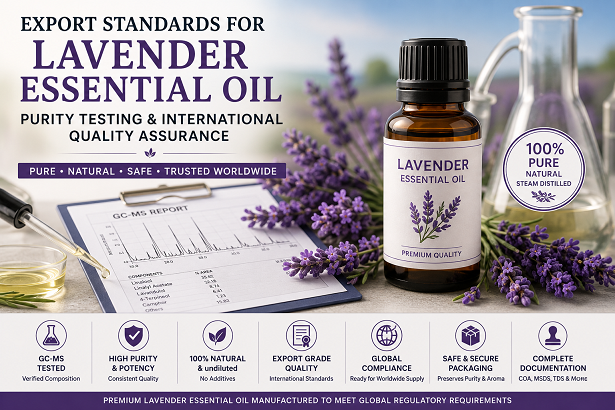
Why Export Standards Matter for Lavender Essential Oil
International buyers no longer evaluate suppliers solely on price. Instead, they focus on quality consistency, transparency, regulatory compliance, documentation, and long-term supply capability. A shipment that fails laboratory testing or does not meet destination-country regulations can result in rejected consignments, financial losses, delayed production schedules, and damage to brand reputation.
Export standards provide confidence that every batch of lavender essential oil has been produced under controlled manufacturing conditions using verified botanical material and scientifically accepted extraction methods. These standards help ensure that buyers receive products with predictable quality, aroma profile, chemical composition, and shelf stability.
Reliable manufacturers also maintain comprehensive quality documentation, allowing buyers to verify authenticity before shipment. This level of transparency is especially important for cosmetic manufacturers, wellness brands, aromatherapy companies, and pharmaceutical businesses that require dependable raw materials.
Businesses interested in supplier evaluation should also read our detailed guide on How to Choose a Reliable Essential Oil Exporter , which explains the key factors international buyers should consider before selecting a manufacturing partner.
Choosing a supplier that consistently follows export standards also simplifies customs clearance, regulatory approvals, private-label manufacturing, and long-term procurement planning.
International Quality Parameters Every Buyer Should Verify
Export-quality lavender essential oil is assessed using multiple quality parameters rather than relying only on its fragrance. Professional buyers typically request laboratory reports, manufacturing details, and technical documentation before approving a supplier.
Some of the most important quality parameters include:
- Correct botanical identity of the lavender plant
- Steam distillation performed under controlled conditions
- Natural aroma without synthetic additives
- Clear appearance free from contamination
- Proper storage to preserve volatile aromatic compounds
- Batch-to-batch consistency
- GC-MS analytical testing
- Complete traceability documentation
- Food-grade or cosmetic-grade packaging where applicable
- Proper labeling for international shipment
Modern buyers increasingly expect suppliers to provide laboratory-backed evidence rather than marketing claims. A manufacturer that openly shares testing procedures demonstrates transparency and builds long-term trust.
Companies producing premium aromatherapy products often compare different extraction methods before choosing ingredients. You may also enjoy reading our article Steam Distilled vs Cold Pressed Oils , which explains why steam distillation remains the preferred method for producing most essential oils, including lavender.
Professional export manufacturers generally maintain quality checkpoints throughout harvesting, raw material selection, distillation, filtration, storage, filling, packaging, and dispatch. This systematic approach minimizes contamination risks while ensuring every batch satisfies customer specifications.
Consistent quality is especially important for brands manufacturing premium shampoos, massage oils, body lotions, facial serums, aromatherapy blends, soaps, candles, room fragrances, wellness products, and personal care formulations. Manufacturers cannot afford variations in aroma or chemical profile because even small differences may affect the final product's performance and consumer experience.
Laboratory Testing Required Before Export
Laboratory testing forms the foundation of international quality assurance for lavender essential oil. Professional buyers almost always request analytical reports before confirming large orders because laboratory testing provides objective evidence that the oil meets agreed specifications.
One of the most widely requested analytical techniques is Gas Chromatography-Mass Spectrometry (GC-MS). This sophisticated testing method identifies the naturally occurring aromatic compounds present in lavender essential oil and helps verify botanical authenticity. GC-MS testing also assists buyers in detecting adulteration, contamination, or the presence of synthetic substances that could compromise product quality.
In addition to GC-MS analysis, manufacturers may provide several other technical documents depending on customer requirements and destination-country regulations. These commonly include:
- Certificate of Analysis (COA)
- Material Safety Data Sheet (MSDS/SDS)
- Technical Data Sheet (TDS)
- Specification Sheet
- Certificate of Origin
- Phytosanitary documentation where applicable
- Batch traceability records
- Packing declaration
These documents enable international buyers to verify compliance before shipment and simplify customs clearance. They also support manufacturers developing private-label cosmetic products, aromatherapy blends, wellness formulations, and export-oriented personal care ranges.
At Shree Overseas Exports, quality assurance plays a central role in manufacturing operations. Buyers seeking dependable export partners often prioritize suppliers capable of providing complete technical documentation together with consistent product quality and professional packaging solutions.
International Certifications and Compliance Required for Export
International buyers increasingly prefer suppliers that operate under recognized quality management systems and maintain compliance with applicable export regulations. Although certification requirements vary depending on the importing country and intended application of the oil, maintaining internationally accepted standards demonstrates a manufacturer's commitment to quality, traceability, and product consistency.
For cosmetic brands, aromatherapy companies, wellness product manufacturers, and private-label businesses, certification provides confidence that every batch is produced under controlled manufacturing conditions. Buyers often include certification requirements in procurement contracts to minimize supply chain risks and ensure regulatory compliance.
Some of the commonly requested certifications and compliance documents include:
- ISO 9001 Quality Management System
- Good Manufacturing Practices (GMP)
- Certificate of Analysis (COA)
- Material Safety Data Sheet (MSDS/SDS)
- Technical Data Sheet (TDS)
- Batch Traceability Records
- Certificate of Origin
- Export Documentation
- Phytosanitary documentation where applicable
- Private-label manufacturing documentation
Buyers also evaluate a supplier's manufacturing capability, infrastructure, documentation process, and packaging facilities before entering long-term business relationships. Companies capable of supplying complete documentation generally experience faster approval cycles and smoother international shipments.
You can learn more about our manufacturing capabilities by visiting our Infrastructure & Packaging page.
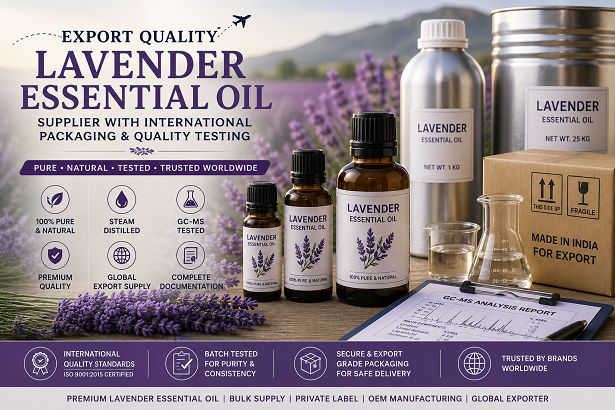
Packaging Standards for Export Quality Lavender Essential Oil
Packaging is one of the most overlooked aspects of essential oil exports, yet it plays a major role in maintaining product quality during international transportation. Essential oils contain delicate aromatic compounds that may deteriorate if exposed to excessive heat, sunlight, oxygen, or contamination.
Professional exporters use packaging specifically designed for volatile botanical oils. Depending on customer requirements and shipment quantity, lavender essential oil is commonly supplied in:
- Amber glass bottles
- Aluminium bottles
- Food-grade HDPE containers
- Epoxy-coated galvanized steel drums
- UN-approved export containers
- Bulk industrial packaging for manufacturers
Proper sealing, tamper-evident closures, moisture protection, and correct labeling help preserve product integrity throughout international logistics. Export packaging must also withstand handling during sea freight, air freight, and customs inspections without compromising the oil.
Professional packaging normally includes:
- Batch number
- Manufacturing date
- Net weight
- Country of origin
- Storage recommendations
- Safety information
- Product identification
Modern buyers increasingly appreciate suppliers capable of offering customized packaging for OEM and private-label manufacturing. Flexible packaging solutions help businesses launch premium product lines while maintaining brand consistency.
How Buyers Evaluate a Reliable Lavender Essential Oil Exporter
Selecting the right supplier involves much more than comparing prices. Experienced buyers evaluate technical expertise, production capacity, documentation, communication, consistency, and long-term reliability before placing commercial orders.
Some of the most important evaluation factors include:
| Evaluation Factor | Why It Matters |
|---|---|
| Manufacturing Experience | Ensures consistent production quality. |
| Quality Assurance | Maintains batch consistency through laboratory testing. |
| GC-MS Testing | Verifies botanical authenticity and purity. |
| Export Documentation | Simplifies customs clearance. |
| Packaging Capability | Protects product quality during shipment. |
| OEM Services | Supports private-label product development. |
| Communication | Improves long-term business relationships. |
| Supply Capacity | Ensures uninterrupted deliveries. |
Businesses launching their own brands often prefer manufacturers capable of offering formulation support, customized packaging, branding assistance, and flexible order quantities. These additional services reduce product development time while improving supply chain efficiency.
If your company is planning to launch a branded aromatherapy or cosmetic range, you may also explore our OEM & Private Label Manufacturing Services.
Global Applications Driving Lavender Essential Oil Demand
Lavender essential oil continues to experience strong international demand because it serves multiple industries rather than relying on a single market segment. Its versatility allows manufacturers to develop a wide variety of premium products using the same botanical ingredient.
Today, lavender essential oil is widely used in:
- Aromatherapy products
- Massage oils
- Hair oils and scalp treatments
- Natural shampoos
- Conditioners
- Facial serums
- Body lotions
- Luxury soaps
- Candles
- Room sprays
- Home fragrance products
- Spa products
- Wellness gift collections
- Private-label cosmetic ranges
As consumers increasingly prefer plant-based ingredients, manufacturers continue expanding their portfolios with botanical formulations containing essential oils. This long-term shift toward naturally derived products has strengthened demand for export-quality lavender oil across North America, Europe, the Middle East, Australia, and Asia-Pacific markets.
For readers interested in understanding lavender oil's commercial applications and worldwide popularity, we also recommend reading our related article: What is Lavender Essential Oil? Benefits and Market Demand .
Manufacturers combining premium essential oils with high-quality carrier oils can also develop advanced scalp care, wellness, and cosmetic formulations that align with evolving consumer preferences for clean-label ingredients.
Buyer Checklist Before Importing Lavender Essential Oil
Choosing the right supplier is one of the most important decisions for any importer, cosmetic manufacturer, aromatherapy brand, or private-label company. Beyond comparing prices, buyers should carefully evaluate quality systems, manufacturing practices, documentation, and after-sales support. A reliable exporter becomes a long-term business partner rather than just a product supplier.
Before placing your first commercial order, consider the following checklist:
- ✔ Verify the botanical name of the lavender used for extraction.
- ✔ Confirm that the oil is produced through steam distillation.
- ✔ Request a recent GC-MS report for every production batch.
- ✔ Ask for Certificate of Analysis (COA), MSDS/SDS, and Technical Data Sheet.
- ✔ Review the supplier's manufacturing infrastructure and quality control process.
- ✔ Ensure export packaging is suitable for long-distance transportation.
- ✔ Check whether OEM and private-label services are available.
- ✔ Verify production capacity for long-term supply contracts.
- ✔ Confirm traceability of raw materials and production batches.
- ✔ Evaluate communication, technical support, and responsiveness.
Suppliers capable of meeting these requirements generally provide greater consistency, fewer shipment issues, and stronger long-term partnerships for international buyers.
Future Market Outlook for Lavender Essential Oil
The global market for lavender essential oil continues to expand as consumers increasingly choose products made with naturally derived botanical ingredients. Demand is being driven by the rapid growth of aromatherapy, wellness products, clean beauty, herbal cosmetics, personal care products, luxury home fragrances, and premium spa formulations.
Private-label manufacturing has also become a major contributor to market growth. Many businesses now launch their own branded essential oil collections, hair care products, skincare lines, massage oils, candles, and wellness products using export-quality lavender oil supplied by experienced manufacturers.
Innovation within cosmetic formulations continues to increase demand for premium botanical ingredients. Manufacturers are combining lavender essential oil with carefully selected carrier oils, herbal extracts, and plant-derived actives to create high-value formulations that appeal to modern consumers.
As sustainability and product transparency become more important, international buyers increasingly prefer suppliers that emphasize responsible sourcing, quality assurance, modern manufacturing infrastructure, and comprehensive technical documentation.
For internationally recognized guidance on essential oil quality and terminology, buyers can also refer to the International Organization for Standardization (ISO), which publishes internationally accepted standards for numerous essential oils and quality management systems.
Conclusion
Export-quality lavender essential oil represents much more than a pleasant fragrance. It is a technically evaluated botanical ingredient whose purity, chemical composition, manufacturing process, documentation, and packaging all influence its suitability for international markets.
Businesses sourcing lavender essential oil should prioritize suppliers that maintain rigorous quality assurance procedures, perform laboratory testing, provide complete export documentation, and consistently deliver products that meet global expectations. Investing in a reliable manufacturing partner helps reduce supply-chain risks while improving product consistency and customer confidence.
At Shree Overseas Exports, we specialize in manufacturing and exporting premium-quality essential oils, carrier oils, herbal powders, herbal hair colors, and natural cosmetic ingredients for customers across the globe. Our focus on quality, transparency, and customer satisfaction enables us to support brands ranging from emerging startups to established international businesses.
Frequently Asked Questions (FAQs)
1. What documents are required when exporting lavender essential oil?
Export shipments commonly include a Certificate of Analysis (COA), Material Safety Data Sheet (MSDS/SDS), Technical Data Sheet (TDS), Certificate of Origin, commercial invoice, packing list, and other documentation required by the importing country.
2. Why is GC-MS testing important for lavender essential oil?
GC-MS testing verifies the natural chemical composition of lavender essential oil, helping buyers confirm authenticity, purity, and batch consistency before purchase.
3. Which industries use export-quality lavender essential oil?
Lavender essential oil is widely used in aromatherapy, skincare, hair care, cosmetics, wellness products, massage oils, spa products, soaps, candles, perfumes, and home fragrance applications.
4. How should lavender essential oil be packaged for export?
Export-quality lavender oil is generally packed in amber glass bottles, aluminium containers, HDPE containers, or industrial drums depending on customer requirements and shipment size.
5. What should buyers look for when choosing a lavender essential oil supplier?
Buyers should evaluate manufacturing capability, laboratory testing, certifications, quality assurance systems, export documentation, packaging standards, production capacity, and customer support before selecting a supplier.
6. Does Shree Overseas Exports provide bulk lavender essential oil?
Yes. Shree Overseas Exports manufactures and exports premium-quality lavender essential oil along with a wide range of essential oils, carrier oils, herbal powders, and private-label solutions for global customers.
If you want expert help, contact us and we will guide you accordingly.