What are the Key Factors to Keep in Mind in Indigo Powder Manufacturing?
The global demand for natural hair care ingredients continues to grow as consumers increasingly prefer plant-based alternatives over synthetic products. Among these botanical ingredients, indigo powder has become one of the most sought-after natural colorants for herbal hair care formulations. Used alongside henna, indigo powder helps achieve various shades of brown and black while supporting healthier hair care routines.
For manufacturers, exporters, cosmetic brands, and private label businesses, producing export-quality indigo powder requires much more than simply grinding dried leaves. Every stage—from cultivation and harvesting to drying, grinding, laboratory testing, packaging, and international compliance—plays a crucial role in maintaining consistent quality. Buyers across Europe, North America, the Middle East, Australia, and Asia expect products that meet stringent quality standards while remaining free from unnecessary additives and contaminants.
If you are planning to source premium herbal ingredients, you may also find our guides on What is Indigo Powder? Benefits and Market Demand, Export Standards for Indigo Powder, Herbal Hair Dye Manufacturing for International Export, and Herbal Hair Color Manufacturing in India helpful.
Why Manufacturing Quality Matters in Indigo Powder Production
Unlike synthetic hair color ingredients, indigo powder is a natural botanical product whose quality depends on agricultural practices, processing methods, storage conditions, and laboratory verification. Poor manufacturing practices may result in inconsistent color performance, reduced pigment concentration, contamination, excessive moisture, or microbial growth.
International cosmetic companies and herbal product brands therefore evaluate suppliers based on much more than price. They prefer manufacturers capable of delivering:
- Consistent natural color performance
- Uniform particle size
- High purity without fillers
- Controlled moisture content
- Microbiologically safe products
- Heavy metal compliance
- Reliable documentation including COA and MSDS
- Export-ready packaging
Maintaining these standards not only improves customer satisfaction but also strengthens long-term relationships with global distributors and cosmetic manufacturers.
Key Factors That Influence High-Quality Indigo Powder Manufacturing
Producing premium indigo powder involves careful control over every manufacturing stage. The following table summarizes the most important factors that determine product quality.
| Manufacturing Factor | Importance | Impact on Product Quality |
|---|---|---|
| Raw Material Selection | Very High | Determines pigment strength and purity. |
| Leaf Harvesting Stage | High | Improves natural color consistency. |
| Drying Process | Very High | Preserves natural active compounds. |
| Grinding Technology | High | Produces smooth, fine powder for better application. |
| Laboratory Testing | Critical | Ensures compliance with international standards. |
| Moisture Control | High | Increases shelf life and prevents spoilage. |
| Packaging Quality | High | Protects product during export transportation. |
| Storage Conditions | Important | Maintains freshness and color stability. |
Selecting Premium Indigo Leaves
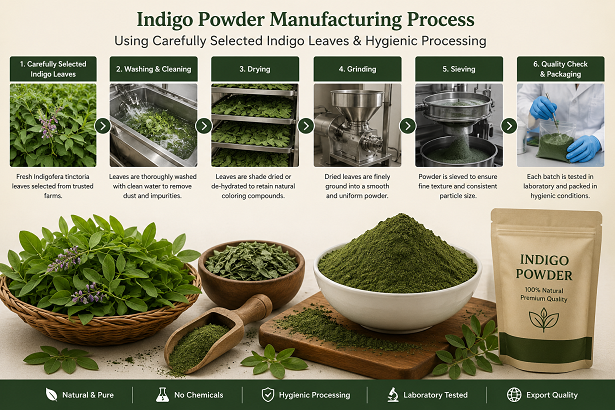
Every high-quality herbal product begins with carefully selected raw materials. Indigo powder is produced from the leaves of Indigofera tinctoria, one of the most widely cultivated plants used for natural hair coloring. Healthy cultivation practices significantly influence pigment concentration and overall product quality.
Manufacturers should source leaves that are:
- Freshly harvested at the appropriate maturity stage
- Free from insects and fungal contamination
- Collected from reliable agricultural sources
- Naturally rich in coloring compounds
- Free from chemical residues wherever possible
- Properly sorted before processing
Working with trusted farming partners also improves traceability, which has become increasingly important for international cosmetic brands seeking transparent supply chains.
Proper Drying Techniques Preserve Natural Quality
Drying is one of the most critical stages in indigo powder manufacturing. Excessive heat may degrade natural pigments, while insufficient drying increases moisture content and creates conditions favorable for microbial growth.
Professional manufacturers generally follow controlled drying practices that maintain:
- Natural pigment stability
- Uniform leaf color
- Low moisture levels
- Reduced oxidation
- Improved shelf life
- Consistent grinding performance
Proper drying ensures the finished powder performs consistently when used in herbal hair dyes, cosmetic formulations, and natural hair care products.
The drying process also influences export quality because many international buyers specify strict moisture limits during procurement.
Grinding and Particle Size Consistency
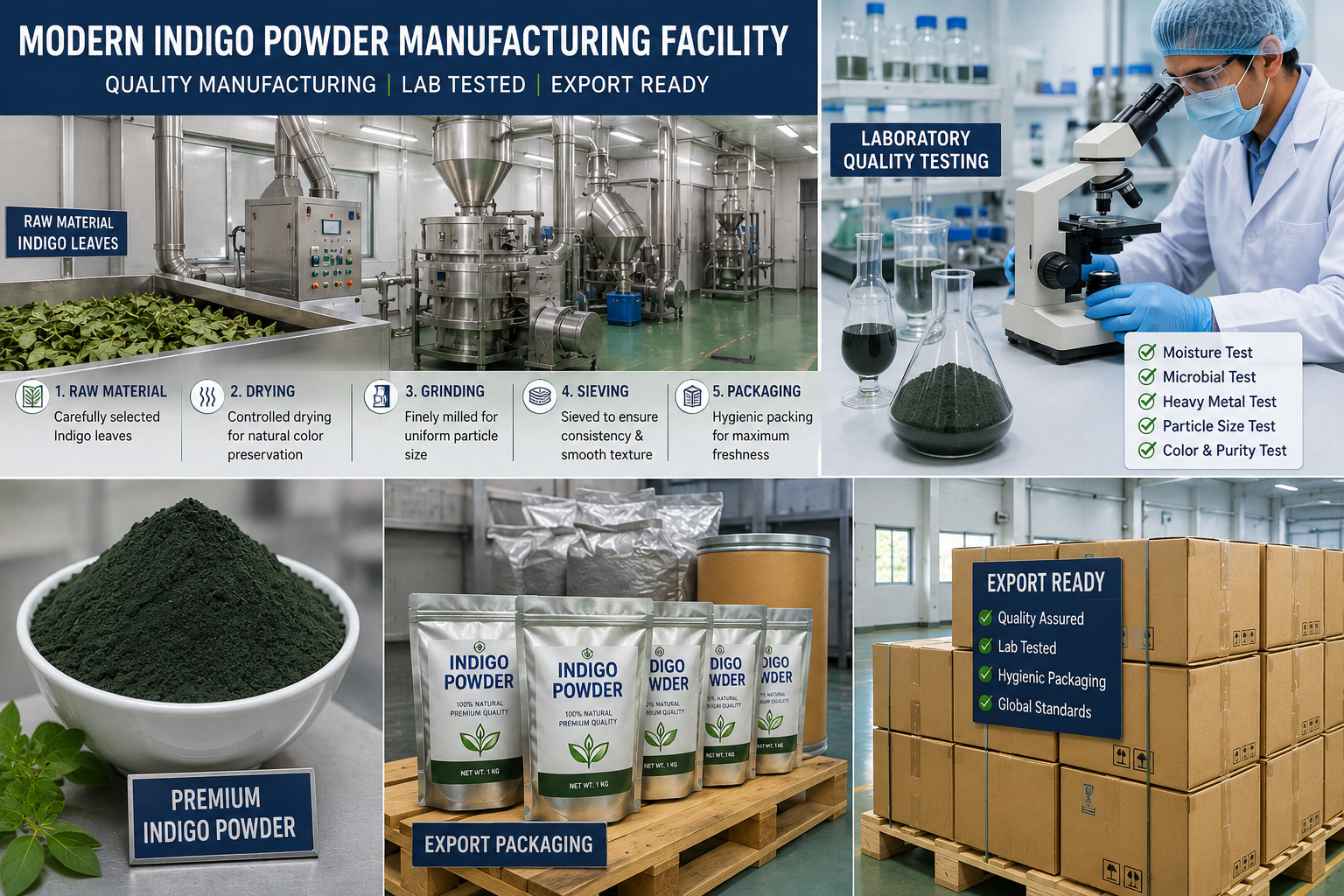
Once the indigo leaves are properly dried, they are processed using advanced grinding equipment to achieve a fine and uniform powder. The fineness of the powder directly affects product performance, ease of mixing, and customer satisfaction. Cosmetic manufacturers and herbal hair care brands generally prefer finely milled indigo powder because it blends easily with henna and creates a smoother paste during application.
Professional manufacturers use hygienic milling systems that reduce contamination risks while preserving the natural properties of the leaves. Uniform particle size also helps improve packaging consistency and product appearance.
Well-manufactured indigo powder should exhibit:
- Uniform fine texture
- Minimal coarse particles
- Easy mixing with water
- Smooth application on hair
- Consistent natural coloring performance
- Excellent compatibility with herbal formulations
Laboratory Testing and Quality Assurance
International buyers increasingly require laboratory-tested botanical ingredients before approving suppliers. Quality assurance is therefore one of the most important aspects of indigo powder manufacturing. Testing verifies product purity, safety, and consistency while helping manufacturers meet regulatory requirements in different export markets.
A comprehensive quality assurance program generally includes:
| Quality Test | Purpose |
|---|---|
| Identity Verification | Confirms the botanical source is Indigofera tinctoria. |
| Moisture Analysis | Ensures product stability during storage. |
| Particle Size Analysis | Maintains batch-to-batch consistency. |
| Microbiological Testing | Checks for yeast, mold and harmful bacteria. |
| Heavy Metal Analysis | Verifies compliance with international cosmetic regulations. |
| Foreign Matter Inspection | Ensures product cleanliness. |
| Appearance Evaluation | Maintains consistent product quality. |
Reliable manufacturers also provide supporting documents such as:
- Certificate of Analysis (COA)
- Material Safety Data Sheet (MSDS/SDS)
- Product Specification Sheet
- Technical Data Sheet (TDS)
- Batch Traceability Records
- Quality Certificates where applicable
These documents simplify procurement for importers and demonstrate the manufacturer's commitment to quality and transparency.
Maintaining Hygienic Manufacturing Conditions
Modern herbal ingredient manufacturing follows strict hygiene practices to reduce contamination and maintain product integrity. Production facilities should operate under documented quality systems that cover personnel hygiene, equipment sanitation, environmental monitoring, and raw material handling.
Important hygiene measures include:
- Clean processing rooms
- Stainless steel processing equipment
- Controlled air quality
- Protective clothing for production staff
- Routine equipment cleaning and maintenance
- Separate storage for raw materials and finished goods
- Proper pest control programs
Following these practices helps manufacturers consistently deliver export-grade indigo powder suitable for cosmetic, herbal, and personal care applications.
Packaging Requirements for International Export
Even premium-quality indigo powder can lose its quality if packaging fails to protect it during transportation. International shipments often travel for several weeks, making moisture protection and packaging durability essential.
Export-ready packaging generally provides:
- Excellent moisture protection
- Protection against sunlight exposure
- Reduced oxygen exposure
- Tamper-evident sealing
- Clear batch identification
- Easy palletization for international shipping
Manufacturers frequently offer multiple packaging options including:
- 100 g and 250 g retail packs
- 500 g and 1 kg private label pouches
- 5 kg and 10 kg industrial packs
- 20 kg and 25 kg export cartons
- OEM customized packaging solutions
Proper labeling should include product name, botanical name, batch number, manufacturing date, expiry date, storage instructions, country of origin, and net weight. Clear labeling improves traceability throughout the international supply chain.
Storage Conditions That Preserve Product Quality
Proper storage is another essential factor in maintaining export-quality indigo powder. Even after production, incorrect storage conditions may reduce product performance and shorten shelf life.
Recommended storage practices include:
- Store in a cool, dry environment.
- Avoid direct sunlight.
- Keep containers tightly sealed after opening.
- Protect from excessive humidity.
- Follow first-in, first-out (FIFO) inventory management.
- Regularly inspect warehouse conditions.
These simple but effective practices help preserve natural color strength, minimize moisture absorption, and ensure the product reaches customers in optimal condition.
Choosing the Right Indigo Powder Manufacturer
For global buyers, selecting the right manufacturing partner is as important as selecting the product itself. A reliable supplier should combine technical expertise, consistent production capabilities, quality assurance systems, and export experience.
Before finalizing a supplier, businesses should evaluate:
- Manufacturing infrastructure
- Laboratory testing capabilities
- Quality certifications
- OEM and private label services
- Production capacity
- Export documentation support
- Packaging customization
- International shipping experience
- Technical customer support
Companies looking for complete herbal hair care solutions may also benefit from our articles on Export Standards for Indigo Powder, Herbal Hair Color Manufacturing, How Herbal Hair Dyes are Manufactured for International Export, and Indigo Powder Benefits and Market Demand.
For additional information about botanical ingredient quality and cosmetic safety practices, businesses can also refer to the International Organization for Standardization (ISO), which publishes globally recognized quality management standards widely followed by manufacturers and exporters.
Frequently Asked Questions (FAQs)
1. What is the most important factor in manufacturing high-quality indigo powder?
The quality of the raw Indigofera tinctoria leaves is the foundation of premium indigo powder. Proper harvesting, hygienic processing, controlled drying, fine grinding, and laboratory testing all contribute to producing export-quality products.
2. Why is laboratory testing necessary for indigo powder?
Laboratory testing verifies moisture content, microbiological safety, heavy metal compliance, purity, and overall product consistency. It also helps manufacturers comply with international cosmetic and herbal product regulations.
3. Which industries use export-quality indigo powder?
Export-quality indigo powder is widely used in herbal hair dyes, natural cosmetics, ayurvedic products, personal care formulations, botanical ingredient manufacturing, and private label hair care brands worldwide.
4. What documents should an indigo powder exporter provide?
Professional exporters generally provide a Certificate of Analysis (COA), Material Safety Data Sheet (MSDS/SDS), Product Specification Sheet, Technical Data Sheet (TDS), batch traceability records, and export documentation as required by international buyers.
5. Why is moisture control important in indigo powder manufacturing?
Maintaining appropriate moisture levels helps preserve product quality, prevents microbial growth, improves shelf life, and ensures the powder remains suitable for long-distance international transportation.
6. What packaging is recommended for exporting indigo powder?
Moisture-resistant, food-grade, tamper-proof packaging with clear labeling is recommended. Packaging should protect the product from humidity, sunlight, and contamination during storage and international shipping.
7. How can businesses choose a reliable indigo powder manufacturer?
Businesses should evaluate manufacturing infrastructure, laboratory facilities, quality assurance systems, certifications, export experience, OEM capabilities, packaging options, and customer support before selecting a supplier.
8. Is indigo powder suitable for private label herbal hair care brands?
Yes. Many manufacturers offer OEM and private label services, allowing businesses to launch customized herbal hair care products using export-quality indigo powder under their own brand name.
If you want expert help, contact us and we will guide you accordingly.
Author
References
-
International Organization for Standardization (ISO)
https://www.iso.org -
World Health Organization (WHO) – Quality Control Methods for Herbal Materials
https://www.who.int - Botanical and Herbal Ingredient Quality Guidelines for Cosmetic Manufacturing
Conclusion
Manufacturing premium indigo powder requires much more than processing plant leaves into a fine powder. Every stage—including raw material selection, controlled drying, hygienic grinding, laboratory verification, quality assurance, packaging, storage, and export documentation—contributes to producing a product that meets the expectations of global cosmetic and herbal care industries.
As international demand for natural hair care solutions continues to increase, buyers are increasingly seeking manufacturing partners capable of delivering consistent quality, complete documentation, and reliable export support. Companies investing in modern production facilities, advanced quality control systems, and internationally accepted manufacturing practices are well positioned to serve growing global markets.
Whether you are developing a new herbal hair care brand, expanding your cosmetic product range, or sourcing botanical ingredients for international distribution, selecting an experienced indigo powder manufacturer can significantly improve product consistency, regulatory compliance, and long-term business success.
Looking for Export-Quality Indigo Powder?
Shree Overseas Exports manufactures and exports premium-quality indigo powder for herbal hair dyes, cosmetic manufacturing, ayurvedic formulations, and private label brands worldwide. Our products are manufactured under stringent quality control procedures with comprehensive laboratory testing, export-ready packaging, and complete documentation to support international buyers.
Whether your business requires bulk quantities, OEM manufacturing, or customized private labeling, our experienced team can provide solutions tailored to your specific requirements.